
City Edge - The story of how two Dublin local authorities are collaborating to reimagine industrial Dublin
What are the barriers to shaping climate-just, resilient communities in Dublin? What role does governance, data and collaborative planning play in creating liveable cities for the future? How can we shift from mapping the system to reimagining it? by Helen Shaw
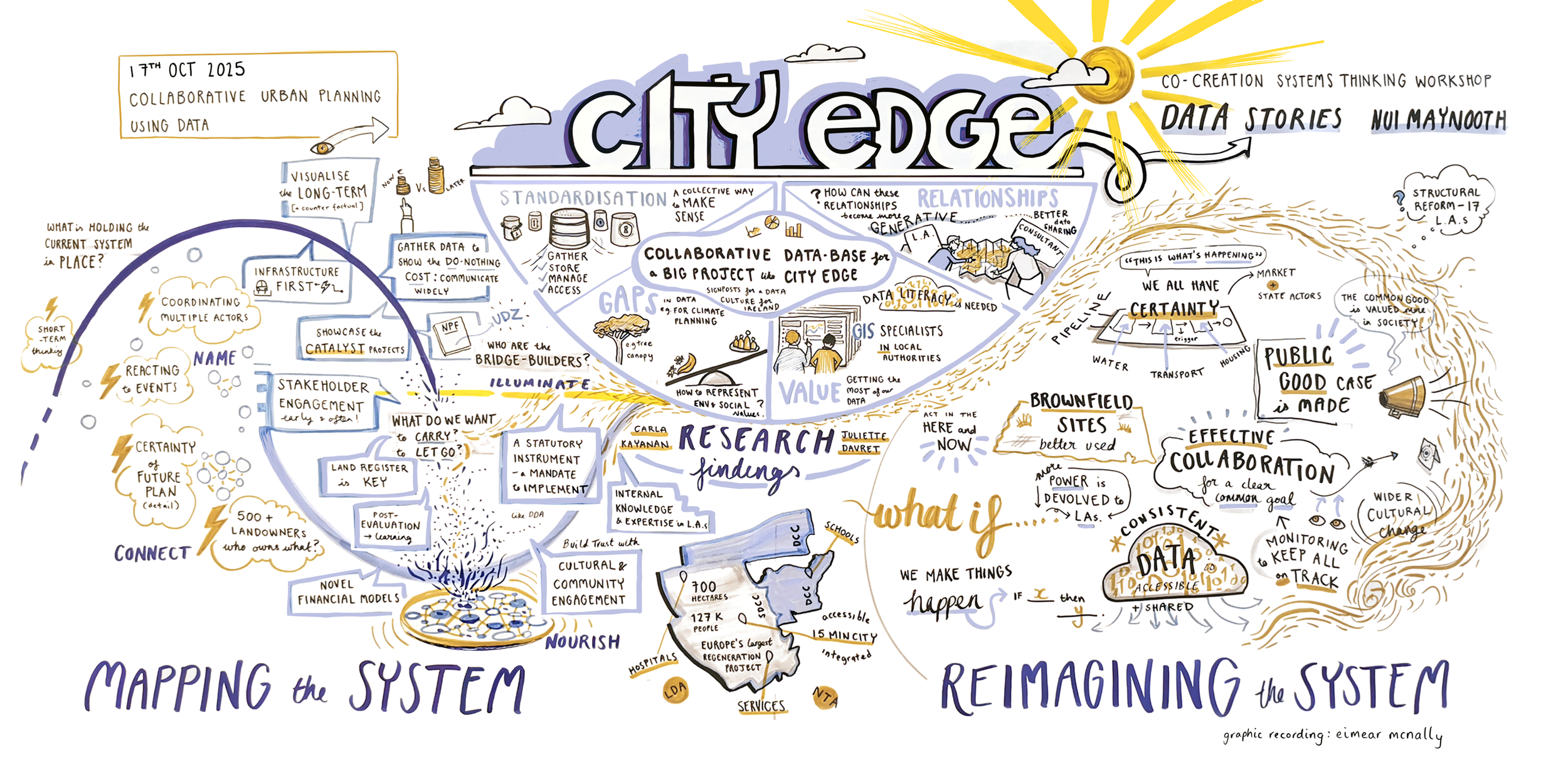
graphic recording of the City Edge, creative co-creations systems thinking workshop in October 2025 by Eimear McNally
In January 2025 I began a one year residency as a writer/artist with the Data Stories Project, Maynooth University. My interest in doing it came from the work around this website in changing the narrative on housing and homelessness as public policy issue but also because I had just completed an MSc in Climate Change with a thesis on reconciling housing and climate goals in Dublin. That capstone thesis had begun looking at emissions and materials as an issue but after a year’s investigation and a series of expert interviews the conclusions focussed on key frameworks - primarily governance, planning and data. I wrote about it for The Irish Times (Building Blocks to a Climate-Just City, September 14 2024) and created a series on Medium. I got to present my findings at international and national conferences and continued my own research by connecting climate and housing solutions - particularly in biomaterials and wrote for The Irish Times about the unrealised potential for hempcrete in Ireland (The House That Hemp Built, July 31 2025), a transformative biomaterial in construction and retrofitting. The use of agricultural land for solar when we have barely begun to employ it on residential roofs was also a climate solutions topic I covered for the Irish Examiner (September 18, 2025).
With the Data Stories Project I was keen to work with Dublin City Council (DCC) on a planning project that included climate resilience thinking. In February 2025, with Dr Juliette Davret, a post-doctoral researcher with the Project, I meet Malachy Bradley, Deputy City Planner, to explore a collaborative case study. Ballyboggin, the redevelopment project in Dublin’s Northside was in my mind but when Dublin City Council came back with a suggestion it was an intriguing Dublin planning project - City Edge - the redevelopment of a largely industrial zone into a new Dublin sustainable town. City Edge, I learnt along the way, was the marketing name given to an ambitious, masterplanning exercise that began just before the pandemic. It is a joint 50 year regeneration project by DCC and South Dublin County Council, covering 700 hectares around the Naas Road, Ballymount, and Park West districts. It is an area as big as the Phoenix Park and while few Dubliners have heard of ‘City Edge’ they know this area well. It is that south city stretch from Kilmore to the Red Cow, home to sprawling car show-rooms, warehouses and dated industrial parks. While Ballyfermot is just before it, the City Edge lands are not currently residential - there is about five thousand people living there but one of the prime sites, at Kilmore, the old Royal Liver retail park, was acquired by the Land Development Agency in January 2025 for housing and is now progressing.
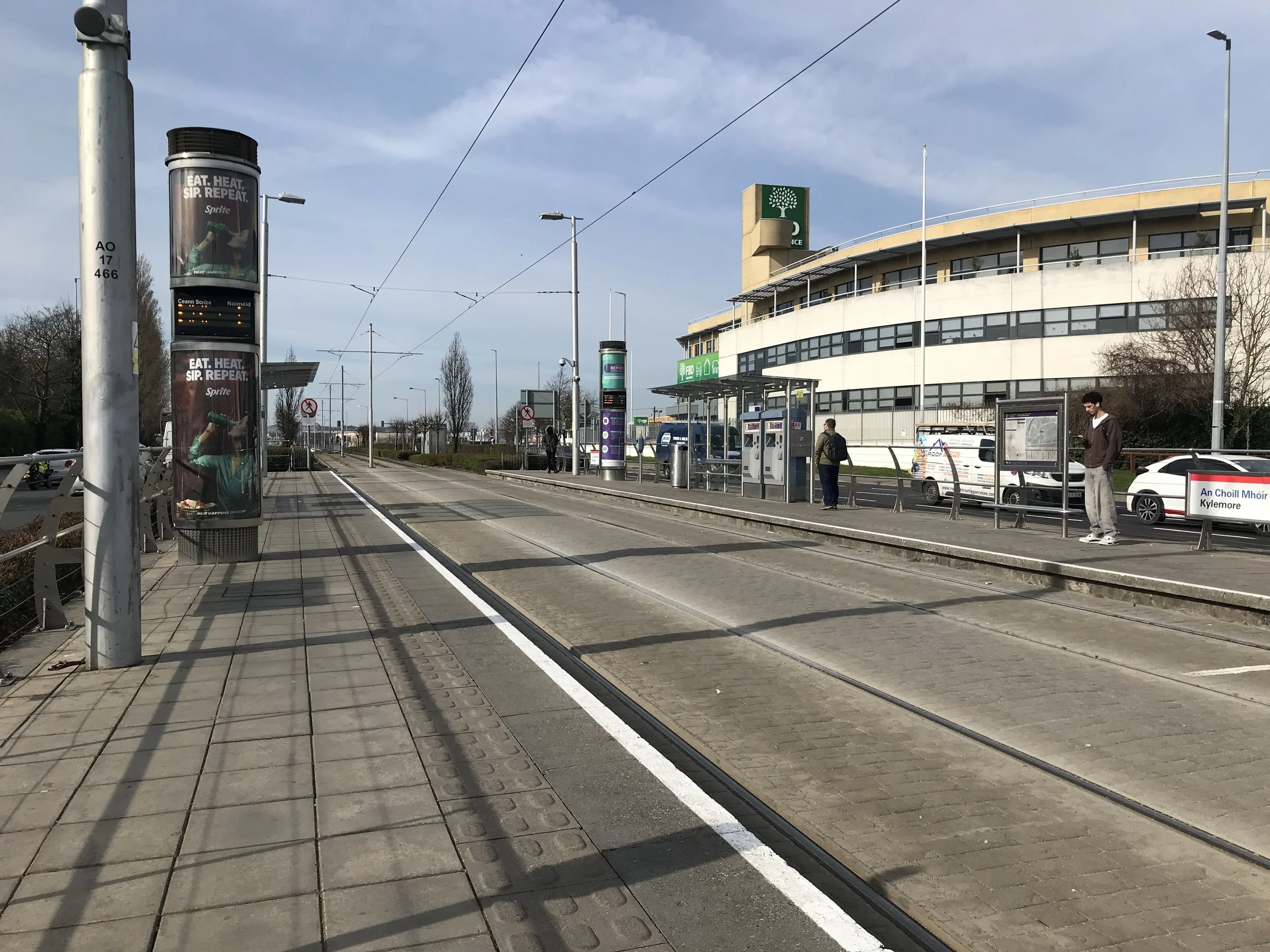
In March 2025, to seed the collaboration I invited the two Data Stories academics, Dr Davret and Dr Carla Kayanan, to join me on a walking tour around part of the zone, starting at Kilmore Luas Stop and mapped a piece for Medium : ‘Can an ageing industrial zone become a sustainable new Dublin town?.
Across the year we conducted detailed interviews with the planning teams in both local authorities, with the many private consultancies employed to support the masterplan, and with the Land Development Agency. In October 2025 I facilitated a creative workshop, with the incredible input of visual graphic reporter Eimear McNally, with the planners and academics involved to explore learnings and findings. Dr Davret and Dr Kayanan are distilling their research findings in academic papers but from my perspective this deep dive into the reimagining of a brownfield zone - one of the last opportunities to create a new town within the city - was an opportunity to test those ideas of how we reconcile and integrate climate solutions into the urgency of housing needs. I returned to three groups, DCC, SDCC and the Land Development Agency, separate to the academic interviews, and recorded audio interviews about the challenges in masterplanning when so much of our city is governed in silos. In DCC Deputy City Planner, Brian Keaney, who was part of the origination of the City Edge project in SDCC before his move to DCC, was generous with his time - ““If we’re supposed to be building compact cities and compact growth, this whole concept of the 15 minute city, has to be in locations like this”, he said pointing to the City Edge map. Siobhan Duff, Senior Executive Planner, SDCC, where the bulk of the City Edge lands sit, said place-making was at the heart of the shared vision for City Edge. At the Land Development Agency Cillian Lehmann, Public Lands Database Manager, and Tadhg Daly, Senior Planner described their role in the collaborative process. Tadhg Daly, who previously worked with DCC, described City Edge as a “ground-breaking project” - but one with multiple complexities. “It’s essentially seeking to build a settlement of nearly the living and working population of Galway City, but within the M50 on already developed lands”.
Greater Dublin has four separate local authorities, DCC, SDCC, Dun Laoghaire Rathdown and Fingal. Each has its own development plan, each has its own climate action plan. Protocols in planning are not harmonised across all four. While all four pull on a small set of central data sources, including Central Statistics Office (CSO), National Transport Authority (NTA) and Land Register, there are significant gaps - particularly in data relevant to climate, energy and environment. Some of those threads came together in a piece in March 2026 called City Visions, drawing on the audio stories and I have now added the audio podcasts to This Is Where We Live.
What is clear from these in-depth interviews is the level of personal commitment and ambition amongst the city planners to re-shaping a sustainable and liveable city. But, just as in my primary research for the MSc thesis, the issue of governance - how we govern Dublin City and County and how we plan it as an integrated system, is the critical barrier to realising that ambition. Governance tops data. We need better information to plan but we need a governance model that envisions the city and its suburbs as a whole - not just in terms of housing unit, but in every aspect of a liveable city; transport, schools, employment, healthcare, green spaces, water, energy and culture. While the City Edge Strategic Framework Masterplan published in August 2022 embodied a 15-minute city model, with 50% green space cover, and had a clear climate resilience vision, the challenges of achieving and implementing vision are real and compelling. Both local authorities are moving ahead with variations on their separate development plans to progress sections of the City Edge Vision. There is a high level of coordination across the two local authorities and the LDA but in the political expediency of mass housing units at speed the long-term vision of sustainable communities in livable low carbon cities can be compromised.
What was intriguing about City Edge from the beginning - beyond its ambition - was that this was the first planning collaboration between two Dublin local authorities. Its genesis and drive appeared to come from visionary people leading in those two authorities rather than a process being baked into the city planning system. The risk then is that when those people move on the siloed approach returns as the process and the system has not changed. While further cross collaborative projects, between other Dublin local authorities and other agencies, were mentioned, these have not been realised. Dublin remains a highly siloed planning environment with competition between the local authorities rather than coordinated collaboration. In December 2022 The Citizens Assembly on Dublin recommended governance change - a Metropolitian authority - and a democratically elected Mayor. The Government committed to a response within six months - but the reality is that report on Dublin has been shelved and overtaken by a Task Force focussed more narrowly on a broken inner city. In further essays on the City Edge case study, and what it tells us about envisioning and realising a liveable city for all, I’ll unpack and try to weave together many of the threads made visible through it.